People 

 Latest News 
Site Search

Sign up for our
free e-newsletter


Send us your latest local news and events

Derren Brown, healing and psychology of belief

JamesKnight300Regular Network Norfolk columnist James Knight gives his take on the recent Channel 4 Derren Brown programme Miracles for Sale and the psychology of belief.

Over the Easter weekend I decided to watch Derren Brown's new programme ‘Miracles for Sale’, which was aired on Channel 4.  I thought it might be a useful addition to my project on psychology of belief and the patterns found throughout beliefs one observes. 
 
The premise of the show is that in order to expose faith-healers as being con-men or charlatans Derren Brown attempted to train an ordinary member of the public as a faith healer.  After lots of training they took him out to Texas (the heart of the Bible Belt), and tried to pass him off as a UK pastor with the gift of healing.  Derren Brown makes it quite clear that:
 
“This programme is not a comment on the church, or belief, or even, before some people get upset, the idea that God can or can’t heal. It is about a specific fraud, a greedy trick that has nothing to do with God whatsoever, beyond the fact that his name gets shouted around a lot. We made the show with the involvement of Christians and pastors who had been involved in that particular scene.”
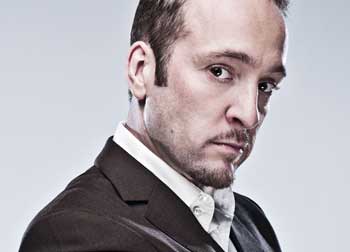
 
DerrenBrownAs a Christian watching the show, although I couldn’t support their mendacity, I found myself largely on the side of Derren Brown (pictured right courtesy of Channel 4) and his assistants - as we were given a tour of the many fraudsters who were conning genuine believers by having inside information about them and using that information to feign Divine prescience.  
 
In some cases the pastors even had information fed via a secret microphone, which they then presented as Holy-Spirit inspired prophecy – convincing the believers that God was imparting special knowledge, and that such knowledge was worth a few dollars in the collection bucket. 

 
I should imagine that most Christians would be appalled at this; but of course, the atheists have been buoyed by the programme - it has compounded what they thought they already knew - that healing is a sham or a delusion, and this show helped reinforce their position. 
 
I thought this is worth sharing because I once attended Davey Falcus's testimony night when he came to Norwich, and saw God heal many through him. That night I was moved in ways like I’ve never been moved before.  I met a woman whose right leg was deformed.  She told me the Lord had spoken to her and that she was going to be healed that night.  Imagine my astonishment as I saw her walk to the front (with help) and observe Davey pray over her - and her fully healed leg was restored, allowing her to walk properly.  I might have been even more astonished if I hadn’t just seen a woman who was blind in one eye miraculously have her site restored.  This is another (different) evening that someone actually filmed - here's a clip...

http://www.youtube.com/watch?v=bYoCHFGMjVc

What we have, inevitably, is the irresistible force of grace meeting the (nearly) immovable object of scepticism – the atheists will think my experiences must be delusion, yet grace is so expansive one can hardly be blamed for embracing miracles when they believe God created the whole universe. 
Of course, I can just about agree with the more eloquent atheist spokesmen like Christopher Hitchens, in that one's sense of decency is outraged every day at extremism.  The epitome of disfiguring the gospel comes in the surrendering of the mind to behaviour that tarnishes the reputation of Christianity through some way of life that seems far worse than atheism. 
 
To that end what the atheist disapproves of the intelligent and wise Christian is likely to disapprove of as well. The show exposes some obvious conmen, who later admit their guilt.  But it remains a big question whether in some cases the showmen who preach the 'sow and ye shall reap’ gospel that they've redefined as a gospel of financial incentive really do find themselves starting to believe it, or whether they have just gotten so used to spin that everything that smells of 'prosperity' blends together as a fait accompli Christian mandate.
 
What disturbs me is that when the sick and poor do not get the results they are hoping for the pastors have no compunction about telling them their lack of success is because they didn't have enough faith.  This is serious pathology, because it shows an insidious detachedness from the personal emotions of those most in need, and it paints God as some sort of celestial tyrant who enjoys playing with people minds and doling out 'tough luck' stories if they do not pull themselves together.
 
Secondly, it bears resemblance to a pattern of behaviour I've noticed in those most opposed to universalism.  I will try to explain it.  I can just about sympathise with those who believe universalism is inaccurate, I can even accept that some have reason to believe that the Bible talks of an everlasting hell in which the un-saved will be stuck in eternal torment.  I myself have some intelligent Christian friends who cannot find a way to support universalism.  I can, I think, sympathise with their position – after all, most have been conditioned to believe in a set of key doctrines, so their church history has a legacy of firm positions that have probably followed them into adulthood.  But what I think shocks me most is this; taken a certain way, the New Testament verses about hell contain perhaps the most outrageous and disturbing words ever spoken.  That there is any possibility that any human being could become aware of God’s love and grace when ‘Every knee shall bow’ and yet still end up spending eternity knowing he has ended up on the wrong side of the door seems a purely human conception, it seems at odds with the person of Christ, even though He is known to have spoken frankly about a separation.
 
Perhaps the psychological patterns I’ve observed show that when eternal hell is believed in to the extent that a man is willing to speak of hell for the lost with the same manner he might employ to describe a bus not turning up, we are seeing the same patterns of pathology that I mentioned last week when describing the pattern of traits in anti-evolutionist creationists.  In truth, the mere thought of anyone spending eternity in hell for what would be at worst a list of finite crimes ought to induce utter despair and dejection in every man or woman who is capable of rational thought – and the strength or weakness of despair and dejection of any man tells a truth about his psychology.
 
Even if a man cannot bring himself to be a universalist, he ought to be heartbroken at the thought that even one single creature could be relegated to such a fate – and one might suggest it is quite unnatural to speak of hell without expressing the slightest regard and admission that this is the most troubling question in the whole of Christianity – and that a man not troubled may be inadvertently speaking important truths about human psychology and the dangers of this kind of pathology.
 
What I am finding as I study the patterns of belief, against patterns of conviction, is that there are more and more signs that the matter of detail that describes the belief (be it anti-evolution, homosexuality is a sin, people are doomed for hell, or whatever) is almost trivially incidental to the pattern of pathology one observes in a person’s psychology. 
 
If the detail of the beliefs is secondary to the psychological driving force behind the beliefs, then that has important implications for Christian Vs Atheist apoplectics, Christian theorising, and the tracking out of one’s own journey of progression in Christ.  This really could be something hugely significant that hasn’t been given anything like the attention it requires. 
 
A lucid development of this project could help us make great inroads, not only in the domain of Christian apologetics, but also in the interest of sectarianism and disagreements within Christianity from the varying factions and denominations. That there is only one Lord is a comfort that works hugely in our favour.
 
Continued next time.


The views carried here are those of the author, not of Network Norwich and Norfolk, and are intended to stimulate constructive debate between website users. We welcome your thoughts and comments, posted below, upon the ideas expressed here. You can also contact the author direct at james.knight@norfolk.gov.uk  

James is a Christian writer and local government officer based in Norwich.
You can access his current collections of columns here 

Meanwhile, if you want to find out more about Christianity, visit: www.rejesus.co.uk


Feedback:
(page   1   2   3)
Grace Enjoyer10/05/2011 22:37
The Latent Power of The Soul is part of a complete work called The Spiritual Man. It should be read in the context of the whole work. It is available here for free. www.lsm.org

Chris11/05/2011 17:46
Yes the Latent power of the Soul was originally part of The spiritual man written by Watchman Nee.

I’ve read The Spiritual man and I can honestly say it’s a life changing book, apart from Living Stream Ministry the only other source of Nee’s books is Stephen Kaung who translated Watchman Nee’s teachings into 55 books, he was also a close friend and co worker of brother Nee.

The Spiritual Man:

http://www.worldinvisible.com/library/nee/sprtmnv1/1968cont.htm

The Complete Works of Watchman Nee [CD-ROM]
55 books in PDF:

http://www.amazon.co.uk/Complete-Works-Watchman-Nee/dp/0935008845

Timothy Reeves17/05/2011 19:18
Re: Nee's "Latent Power of the Soul".

The argument for Adam's psychic power is extremely weak: Injunctions relevant to humanities duty of stewardship over the Earth doesn't in itself imply unber-man powers.

But however spuriously derived I certainly do agree with Nee's objections to all occult practice.

The "Soulish" category has a marginal Biblical background and is wide open to abuse by gnostic and elitist Christian sects who can arbitrarily categorise what they don't approve of as "soulish" and "not in the spirit".
Grace Enjoyer17/05/2011 21:20
Whatever and however some manipulate scripture does not diminish the fact that rather than
being marginal, the matter of being in spirit or being soulish is a central matter concerning God and his household administration.
We should not and cannot offer true worship to the Lord merely with or in our soul for “the hour is coming and now is, when the true worshippers shall worship the Father in spirit and truth; for also the Father seeks such as his worshippers.”

According to these passages 1corinthians 2:14
James 3:15
Jude 1:19
a soulish person does not receive the things of God nor is able to know them. They are those that make divisions among the believers which would include the Gnostic and elitist sects to which you refer.
There is a wisdom that is earthly soulish and demonic.
“ A soulish man is a natural man, one who allows his soul (including the mind, the emotion, and the will) to dominate his entire being and who lives by his soul, ignoring his spirit, not using his spirit, and even behaving as if he did not have a spirit (Jude 19). Such a man does not receive the things of the Spirit of God, and he is not able to know them. Rather, he rejects them. The religious Jews, who required signs, and the philosophical Greeks, who sought wisdom (1:22), were such natural men, to whom the things of the Spirit of God were foolishness (1:23).”

We should face the painful truth that not many Christians really know what it means to be in spirit, let alone continually walk according to their spirit and I have to include myself.
I suggest that we consider Brother Nee`s work with a humble attitude. As a modern day martyr responsible for raising up the underground local church in China and elsewhere which now comprises countless millions of believers we would do well to consider his ministry. By their fruit you shall know them.
The Spiritual Man and the complete works of Watchman Nee are AVAILABLE FOR FREE HERE
www.lsm.org.
Much Grace.


• Matthew 5:3
Blessed [are] the poor in spirit, for *theirs* is the kingdom of the heavens.
Matthew 5:2-4 (in Context) Matthew 5 (Whole Chapter)
• Matthew 22:43
He says to them, How then does David in Spirit call him Lord, saying,
Matthew 22:42-44 (in Context) Matthew 22 (Whole Chapter)
• Mark 14:33
And he takes with him Peter and James and John, and he began to be amazed and oppressed in spirit.
Mark 14:32-34 (in Context) Mark 14 (Whole Chapter)
• Luke 1:80
-- And the child grew and was strengthened in spirit; and he was in the deserts until the day of his shewing to Israel.
Luke 1:79-80 (in Context) Luke 1 (Whole Chapter)
• Luke 2:40
And the child grew and waxed strong [in spirit], filled with wisdom, and God's grace was upon him.
Luke 2:39-41 (in Context) Luke 2 (Whole Chapter)
• Luke 10:21
In the same hour Jesus rejoiced in spirit and said, I praise thee, Father, Lord of the heaven and of the earth, that thou hast hid these things from wise and prudent, and hast revealed them to babes: yea, Father, for thus has it been well-pleasing in thy sight.
Luke 10:20-22 (in Context) Luke 10 (Whole Chapter)
• John 4:23
But [the] hour is coming and now is, when the true worshippers shall worship the Father in spirit and truth; for also the Father seeks such as his worshippers.
John 4:22-24 (in Context) John 4 (Whole Chapter)
• John 4:24
God [is] a spirit; and they who worship him must worship [him] in spirit and truth.
John 4:23-25 (in Context) John 4 (Whole Chapter)
• John 11:33
Jesus therefore, when he saw her weeping, and the Jews who came with her weeping, was deeply moved in spirit, and was troubled,
John 11:32-34 (in Context) John 11 (Whole Chapter)
• John 13:21
Having said these things, Jesus was troubled in spirit, and testified and said, Verily, verily, I say to you, that one of you shall deliver me up.
John 13:20-22 (in Context) John 13 (Whole Chapter)
• Romans 2:29
but he [is] a Jew [who is so] inwardly; and circumcision, of the heart, in spirit, not in letter; whose praise [is] not of men, but of God.
Romans 2:28-29 (in Context) Romans 2 (Whole Chapter)
• Romans 8:9
But *ye* are not in flesh but in Spirit, if indeed God's Spirit dwell in you; but if any one has not [the] Spirit of Christ *he* is not of him:
Romans 8:8-10 (in Context) Romans 8 (Whole Chapter)
• Romans 12:11
as to diligent zealousness, not slothful; in spirit fervent; serving the Lord.
Romans 12:10-12 (in Context) Romans 12 (Whole Chapter)
• 1 Corinthians 5:3
For *I*, [as] absent in body but present in spirit, have already judged as present,
1 Corinthians 5:2-4 (in Context) 1 Corinthians 5 (Whole Chapter)
• 1 Corinthians 14:2
For he that speaks with a tongue does not speak to men but to God: for no one hears; but in spirit he speaks mysteries.
1 Corinthians 14:1-3 (in Context) 1 Corinthians 14 (Whole Chapter)
• Galatians 3:3
Are ye so senseless? having begun in Spirit, are ye going to be made perfect in flesh?
Galatians 3:2-4 (in Context) Galatians 3 (Whole Chapter)
• Colossians 2:5
For if indeed in the flesh I am absent, yet I am with you in spirit, rejoicing and seeing your order, and the firmness of your faith in Christ.
Colossians 2:4-6 (in Context) Colossians 2 (Whole Chapter)
• Revelation 17:3
And he carried me away in spirit to a desert; and I saw a woman sitting upon a scarlet beast, full of names of blasphemy, having seven heads and ten horns.
Revelation 17:2-4 (in Context) Revelation 17 (Whole Chapter)

Grace Enjoyer17/05/2011 21:35
Just to add, a very interesting programe has just aired on radio 4 All in The Mind. 9- 9.30pm Well worth a listen. http://www.bbc.co.uk/iplayer/
Placebo effect. “Participating in embodied ritual” and “expectations are everything”
The power of the soul receives a medical examination!

Timothy Reeves17/05/2011 23:26
The concept of "soulishness" has been retrospectively and arbitrarily interpolated into the quoted verses. Also let me repeat: The argument for Adam's psychic power is extremely weak: Injunctions relevant to humanities duty of stewardship over the Earth doesn't in itself imply uber-man powers.

However, I have no intention of "discussing" this matter any further with the foregoing cut and paste commentary.
Grace Enjoyer17/05/2011 23:38
1 Thessalonians 5:23
Now may the God of peace Himself sanctify you entirely; and may your spirit and soul and body be preserved complete, without blame at the coming of our Lord Jesus Christ.
tjnihon11/06/2011 15:54
James, I actually found something I can agree with you here. I agree that this Brown guy is off the wall.

But again, I see you playing havoc with God's Word here. In one of your responses to someone you said this:

James said:
“people's rejection of God is not mostly down to positivism, it is down to psychological factors.”

James, what is it with you and psychology? Are you a psychologist or something?

You seem to think that psychology trumps God’s Word.

Jesus told us why people don’t believe in John 3:16-20. “For everyone who does wicked things hates the light and does not come to the light, lest his works should be exposed.”

Psychological factors? Well, if you can find some way to equate the love of sin with psychological factors, I’ll agree. But I prefer the words of the Savior to your way of saying it.

Many people just don’t want to believe because of the changes it would bring or force in their lives
Mark 16:13 “And they went back and told the rest, but they did not believe them.” In this case they didn’t believe because the idea of resurrection was too incredulous for them.


Others have real intellectual problems with the Bible, mostly because they haven’t thoroughly checked it out for themselves or because of the psychological conditioning they have received in school regarding evolution, psychology, religion, etc.

John 4:46 “So Jesus said to him, "Unless you see signs and wonders you will not believe.” These guys were realists who demanded absolute proof. Faith was not an option for them, because faith in not 100% proven. They were sceptics.

Speculating about underlying phsychological causes might be OK, but it is mere speculation. You are here claiming that the real reasons for their disbelief are these psychological factors. That is taking too much liberty with the text. You are putting your own ideas into it. You are treating psychology almost as an infallible truth determining framework through which you interpret the Bible and judge people's hearts.
tjnihon11/06/2011 15:59
James said this:
“I can, I think, sympathise with their position – after all, MOST HAVE BEEN CONDITIONED TO BELIEVE IN A SET OF KEY DOCTRINES, so their church history has a legacy of firm positions that have probably followed them into adulthood.”

James,
You are really something! You think that for a person to believe certain doctrines, the only explanation is conditioning.

Where do you get that idea? From the conditioning you received when you studied psychology?

Did you ever consider “reading God’s Word and believing it?” as an alternative reason?


Have you ever tried to analyze yourself and how you arrived at your beliefs – because it seems pretty clear that you didn’t arrive at your beliefs through reading God’s Word. Whenever you find something you disagree with, you just chose not to believe it.

I don't get it. Yet the bad guys are the people who actually dare to believe what the Bible clearly teaches. You don't seem to have a very high regard for Jesus. He spoke more about hell than about heaven. Whatever you may think of it personally is beside the point. Just because you can't understand it doesn't make it untrue. Your degree of intellectual understanding is not the standard we use to determine truth. Jesus said "Your Word is truth." That is the standard, is it not?
tjnihon11/06/2011 16:03
You said:
“That there is any possibility that any human being could become aware of God’s love and grace when ‘Every knee shall bow’ and yet still end up spending eternity knowing he has ended up on the wrong side of the door seems a purely human conception, it seems at odds with the person of Christ, even though He is known to have spoken frankly about a separation.”

James,

Tell me please, when do you allow God to teach you? When do you allow yourself to be corrected by God’s Word? Has it ever happened? Or do you just find a way to wiggle around all the texts that you don’t agree with?

You claim that Adam possessed a psychic power. Where did that come from? You answered that by saying it came from Watchman Nee. I see. I would have been surprised if you told me it comes from the Bible. It seems you are willing to accept this guy’s opinion in spite of the fact it is not taught in God’s Word, but you cannot accept the clear teachings of God’s Word.

I know. You just dismiss everything I say because you can tell that I’m a poor fundamentalist enslaved to his conditioning. That is how you view my comments for sure. What I’m really interested in knowing is how you view God’s Word when you read it? Is it truth? Does it simply contain a lot of truth? Or just some truth? Etc.

Please tell me what purpose there is in warning a person about something that is not a real danger? Jesus spoke more about helln than about heaven.

It would amount to a lie since there is no chance of them going to hell in your opinion.

Do you believe in heaven? Why? Because it is a nice thing to believe in? Because you can understand it? Because you want to believe in it?

Atheists probably are wondering wHat conditioning you received that explains your belief in heaven. I wonder too.

It doesn't seem like the truth of God's Word has anything to do with it. It is all psychological.


(page   1   2   3)

We welcome article comments from users

To add a comment to most articles you must be a logged-in site member. You can either log-in or quickly sign up to become a site member below.
To join Network Norwich and Norfolk you need to register or login

Network Norwich and Norfolk > People > James Knight > Derren Brown, miracles and psychology of belief
Avg. Rating: *** (21 reviews / comments)
  • Write a review or comment
  •  Norfolk Services