|
The similarities of creationists and atheists

Regular Network Norwich & Norfolk columnist James Knight continues his theme of psychological patterns and sees the similarities in the thinking of new-wave atheists and creationists.
Continuing the theme of psychological patterns – those who have been tuning in so far in this series will have seen that we’ve already reached a pretty important realisation regarding not just the polarising power of these psychological driving forces, but also the internal conflict they cause individuals too. My realisation that the new-wave atheists and the creationists are displaying the same psychological patterns (albeit with different matters of detail in their sound-bytes) has been particularly important in this project.
That the new-wave atheists use creationist material with which to bash mainstream Christians is absurd, and indicative of the fragility of their own case, particularly given that the contemporary mindset is unlike that of the Biblical writers, so any science issue are remiss. In fact, the differences between ancient Hebrews and modern Americans are about as far apart as one can imagine - it seems crazy to think that the Genesis writers were delivering a commentary that we could interpret scientifically five or six thousand years later. So the mainstream Christians (who make up the vast majority) find that their opposition from both sides largely consists of a similar, and pretty incompetent, group. In that sense there is a further commonality between atheists and fundamentalists in that both seem oblivious to the power of the mythological narrative and all its broad resonances, and both only seem able to view the more complex subjects through an over-simplifying lens of black and white.
As those who read the recent very poorly reasoned article from fundamentalist Gary Burchnall would have seen, the language employed by the likes of the Answers in Genesis cult directed at theistic evolutionists is the same sanguinary and abrasive language they use on atheists too. Terms like “Putting words into God's mouth”, “Applying your opinion to scripture”, “Compromising God’s word”, “God means what he says”, “Ignoring God’s word”, “Believing atheistic systems” and threats about turning Christianity into something 'natural' are all part of their repertoire of dismissive intimidation.
I wonder if this is in some part due to the American influence, which as a nation has an imperial feel about it, where its citizens believe that God is doing something special there (exclusive to them), and that to be a part of the great awakening is to have the bestowment of a personal identity with God's word that requires no interpretation or critical analysis. I don’t think this factor can be underestimated, particularly if one bears in mind that the vast majority of this anti-science fundamentalism comes from America (or an implicitly American influence). By dismissing anything that has in the past been associated with church rivalry or even mild deviation while awaiting the full facts, they claim to have God’s direct authority in keeping their fellow men and women on the straight and narrow. Naturally, they have become so accustomed to using implicitly threatening language and hegemonic spiritual duress that those who can be manipulated must feel that they are authority figures who proclaim genuine authority in a world that's gone wrong, whether that ‘authority’ contradicts known facts or not.
That we have a Western world of superficiality, consumerism, spiritual tricks, and increasing departure from the faith makes them feel justified in lumping in things like science and philosophy in their repudiations too, because it isn't difficult to adopt a 'My way or the wrong way' message where the wrong way leads to any one of the un-Christian lifestyles that are exclusively at odds with Christ's teachings. Furthermore, if you can entrap gullible acolytes with creationist mantras that claim the necessity of an alternative to 'naturalistic' science, then you can probably get people to open up their wallets and purses too and invest in movements like Answers in Genesis and the Discovery Institute; institutions that lie to children about the natural world, and peddle distortions on just about every important subject. They are a minority cult-type organisation for which the majority of Christians are forever apologising or having to put the record straight. All this fits nicely for them into a set of sleight of hand tricks where genuine ignorance and delusion become entangled with the desire for power, control, prestige and leadership influence.
The patterns are all too familiar - they resemble the sectarians and the cults in thought and in behavioural patterns, and I guess that before long those who can manipulate others find themselves adopting all sorts of tactics that they would find quite contemptible in any other group environment.
In summary, the symptoms of this kind of Christian seem to be a toxic mix of self-righteousness (how I see God’s infallible world cannot be challenged) and self-negation (I’m not worthy to put my own interpretation on God’s truth), which makes for a pretty frustrating Christian fundamentalist. Thus, the mainstream Christian is really up against it because both atheists and creationists make their living by distorting the true picture of scripture by adding spurious literalism to parts of the Bible that the vast majority of their fellow Christians realise are not to be taken that way.
Furthermore, there is another important point, about which I have written a chapter in one of my books - about how the word of God is not static, but dynamic. One thing is quite clear - one isn't required to take Genesis literally in order to recognise the power of its concepts; just about every Christian I know has no trouble appreciating sin and salvation through the grace of Jesus, so clearly seeing Genesis non-literally hasn't impeded Christians' clarity on sin and the need for a saviour. That fundamentalists place so much emphasis on something that has no bearing on people accepting Jesus shows the first fault - but there is more, because I can formulate a question for which they have no answer, and it takes the following form;
What is added to the reality of sin and falleness in a literal historical Genesis act or event that would be absent in a mythological or allegorical Genesis expression?
You'll find in the cases of early Genesis, the answer is nothing at all. In fact, it's fairly obvious that the reverse is true - were it a literal event it would diminish much of the power of the concept. That's the key word - 'concept' - you see, a concept is a thought or an idea belonging to the mind by taking the generic form of being abstracted from various particulars within the sphere of sense-data. They must realise that sin and being fallen apply here, and that they are not literal objects that can be touched or felt - they are implicitly concept-based, just as pride or happiness or generosity are concepts that are known by what they amount to in the context of literal scenarios.
By imputing a literalism or a physicalism to sin there is the question of the difference between perceptions and conceptions. A sinful action like, say, witnessing a murder is an action that is implicitly 'perceived' by the witness, because it fits the criteria required to fall under the sense-based category distinction. Objects like people and murder weapons have physical properties, their composition constitutes objects that can be experienced with our senses - they can be seen, touched, smelt, heard, and tasted, if one so wishes. And of course, there is naturally an overlap between perception and conception because the murder can be conceived in an explicitly conceptual form (like a memory or in further ideation).
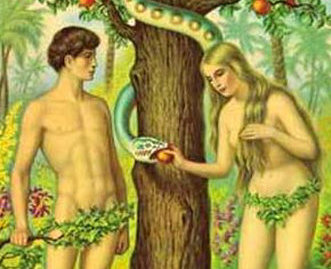
Now non-perceptive aspects of reality are different - they are not physical objects that can be seen or touched or smelt - they are implicitly conceptual because they take the form of an idea or a mental abstraction. So take the concept of sin or goodness or generosity or love or beauty or sublimity - each of these falls into the category distinction of being implicitly conceptual, because they are not shared experiences in the same way that sense-based observations are shared, and they are not 'common sense' friendly. They elicit meaning throughout shared experiences, because they are concepts that have significance conferred upon them in commonality of experience, and communication of those experiences. For that reason it makes no sense to talk of sin being more than a concept.
Trying to define ‘sin’ without the conceptual form is as futile as trying to run away from your own legs. So all this talk of the importance of a literal Genesis is moonshine, because it fails to take from the account the most powerful part of the story – the power of the concept and its reification in actionable form throughout one’s journey with Christ. Forgetting the hermeneutics for a second and concentrating on the psychology that drives it - I have to say few things upset me more in Christianity than a believer who has been indoctrinated to the extent that he has suppressed his faculties of reason to the point that they appear dormantly locked in to the 'inner man' bursting to get out. They are not only a product of brainwashing, they are trapped in a hellish one-dimensional discourse that is stifling the development of the abilities God gave them. And they fool themselves into thinking they're content with this - but I sense they're not; how could anyone be, their continual threads and discussions about this are simply a subliminal method of trying to express the division within themselves. On the one hand all they have on the surface is what authoritarian elders have drummed into them - yet in the oceanic depths of their selfhood is an instinctively rational creature with so many facets of ability and creativity just bursting to get out.
And, of course, to contend that evolution militates against our being sinful or fallen is nonsense – it should be so obvious really. Any evolved being is going to be in a fallen state when fallenness is qualitatively measured against God. We cannot legislate sin or wrongdoing or imperfection out of the system; and of course even the angels bow to Jesus as Lord. But there is a bigger failing of literalism, and we just mentioned it - to stubbornly accept it as a real event and deny its broader conceptual implications is delimiting, because it shuts off the Christian from one of God's key plans for His word - its dynamic development in conceptual form throughout the spread of Christianity in every age, right up to the present day. Not only will God resource His wisdom in contemporary context by having His Holy Spirit help us invest new meanings in the concepts, He will use the present conceptual developments to plant seeds for those unborn folk that are to follow. It is no surprise that this faulty application of literalism where it isn’t warranted is yet another pattern that emerges in both creationist and new-wave atheist alike.
A similar thing happens in ethics - the biblical ethics are not literally history either - they are concepts that are applied to historical events (as seen in the Old and New Testaments) but that can be invested in with new developments as humanity progresses. That's why we have things like business ethics, medical ethics, environmental ethics, to name but three, that we never used to have, but were assimilated into present cultural zeitgeists with recourse to antiquity.
The concepts of sin and falleness work in a similar way to ethics - they are part of a foundational truth applicable to all of mankind, but they cannot be compacted into one historical event with one person because they acquire new contexts when added to different situations in different times. For the same reason that we find the true significance of sin in the power of the concept, we find the true significance early Genesis in the power of the concepts it elicits. To try to package all that power into a literal Adam and Eve is simply to divest it of conceptual power, and in doing so, you unwittingly attempt to rob scripture of some of its spiritual gravitas.
When it comes to a man in relation to God, a man in 2011 is fallen in the same way that a man in 1654 or 1729 is fallen - all of them can only rely on the grace of Christ for salvation. But how they relate that falleness to their own surroundings will differ greatly, just as how a man relates the ethical blueprints to his day depends very much on the period of history in which he lived.
It is on that note that I will close, because next time out I will be tackling the most difficult theological question I have ever faced – one I have been asked by another to tackle; in fact, the only one for which I haven’t managed to construct concepts that have to my satisfaction clearly defined answers.
See you next time
The views carried here are those of the author, not of Network Norwich and Norfolk, and are intended to stimulate constructive debate between website users. We welcome your thoughts and comments, posted below, upon the ideas expressed here. You can also contact the author direct at james.knight@norfolk.gov.uk
James is a Christian writer and local government officer based in Norwich. You can access his current collections of columns here Meanwhile, if you want to find out more about Christianity, visit: www.rejesus.co.uk
|
|
(page
1
2)
| | | Paul Bacon | 08/06/2011 17:12 | I suggest that Mr Knight concentrate more on his job in the local government as he certainly doesn't seem very clued up when it comes to spiritual things.
He is like a man who decides to join a Golf club but when he doesn't agree with the rules (or can't understand them) tries to tell everyone to play cricket.
Mr Knight I suggest you create your own religion and stop speaking in the name of Christianity.
How dare us poor people have the nerve to take the bible literally. I know how reading government reports might make you want to read whatever you want into the text but please leave the Bible out of your conceptualisation nonsense.
If you cannot take what God says as Gospel, then what else don't you agree on? If you don't have the faith to believe that God is able to create the universe in six days then your faith my friend is very weak.
The God I read of in the bible is able to do all things. Nothing is impossible for Him.
You like to say that Fundamentalists (if that is what you like to call us) believe that their own words = God's words. I think that is a bit of a cheek and the pot calling the kettle black.
I say God's words = God's Word. It is you that is trying to distort it into the twisted tripe that you spout.
If you are too proud and arrogant of your own understanding to believe what the Bible says then you need to humble yourself before your creator and repent.
So remember this Mr Knight, I have the cheek to accept the Bible for what it says because I believe God can do all things. It is you that are putting your own words and ideas up against God's word.
(I actually wonder why God took so long to make the universe. He could have taken six nano seconds. But he did that way to set us the guidelines to work six days and rest.)
| | | | Ted Griffith | 08/06/2011 18:06 | Where do we start? I know. Christ. Even if you discounted Genesis you must count the words of Christ - thankfully for us they are recorded. I happen to have a few of them here:
Mark 10:6 "But from the beginning of the creation God made them male and female."
Mark 13:19 "For in those days shall be affliction, such as was not from the beginning of the creation which God created unto this time, neither shall be."
Matthew 24:37 "But as the days of Noah were, so shall also the coming of the Son of man be."
Luke 17:27 "They did eat, they drank, they married wives, they were given in marriage, until the day that Noah entered into the ark, and the flood came, and destroyed them all."
Very complex scriptures? Hardly... These are simple statements by Christ - you do not need a degree in divinity to decipher these statements of history. They are either true or false.
Now if you call yourself a Christian you a follower of Christ. BY definition you believe his words as FACT. If you do not count the words of Christ as fact; How can he be God? How can he be who says he is - How can He be "The Great I Am"?
He cannot. If he links his credibility to Noah, The Flood, Creation of Man and Woman - he links his Deity to it as well. If he is lying he is no God. Leastwise one you can trust your soul with for he could be deceptive on Heaven as well.
You cannot serve God and mammon. You must choose or side or BOTH will cast you out as evil. Either Christ is right or Christ is wrong - place your soul where mouth is and your mouth where your soul is. There is no need to talk out of the side of your mouth and equivocate and give ground to people who would like nothing more than to unravel Christianity by clutching for the threads of Genesis to unwrap the sweater.
| | | | tjnihon | 09/06/2011 00:26 | From your response to Timothy Reeves:
“I won't go into all the accretive aspects of conditioning, but those from a creationist background will likely have had to live through a more intellectually repressive upbringing whereby one's proclivity for autonomous rationale is kept dormant by the overbearing influence of their parents and/or church leaders - so in a quite literal sense their interpretations of the Biblical stories that require symbolic and abstract conceptions are child-like, …. And of course the childlike mentality is reminiscent of the egocentrism of the child who cannot decentre and only really has his own perspective as a vehicle for evaluation.”
James,
“At that time the disciples came to Jesus, saying, "Who is the greatest in the kingdom of heaven?" 2And calling to him a child, he put him in the midst of them 3and said, "Truly, I say to you, unless you turn and become like children, you will never enter the kingdom of heaven. ” Matthew 18
James, I’m happy to be an immature little child when it comes to trust in God’s Word.
I can see you have a way with words. But to be honest, your prose is so flowery in some of your posts that some of us poor ignorant fundamentalists can’t quite even understand exactly it is that you are trying to say. It is like the prose covers up the emptiness of the underlying meaning.
Thank you for sparing us a lecture on “the accretive aspects of conditioning!” I’m sure it is only fundamentalists who are conditioned, right? Your education didn’t have any kind of influence on you, I’m sure. It feels like you liberals are sitting up on top of a mountain looking down on all of us fundies and trying to explain what made us the way we are. A bit judgmental it seems. You presume to know about our oppressive background and struggles with overbearing parents and/or church leaders. That has not been my experience at all and I think this kind of characterization is not helpful except to spread stereotypes and bias. You’ve heard the characterizations, bought into it, and now you are doing your part to spread it. By this attempt to make us look bad, you achieve more satisfaction in your own views, in spite of the fact that you cannot support them from Scripture.
You talk about “Biblical stories that require symbolic and abstract conceptions.” James, again, what are your conditions for determining whether a Biblical story requires symbolic and abstract conceptions? I mean, how do you know which ones are history and which ones are made up stories?
And why can’t a story be both history and also have symbols and abstract concepts in them. The two are not necessarily self-exclusive as you seem to have convinced yourself.
Besides being judgmental, your answer to Tim Reeves also seems quite condescending - you, the intellectual giants, us, the oppressed egocentric little deprived children. Please spare us your concern!
Instead of your put downs and psychological explanations for our state of mind, try answering some of our points.
"Truly, I say to you, unless you turn and become like children, you will never enter the kingdom of heaven.”
| | | FirePrior | 15/06/2011 22:05 | Conditioned by upbringing. No, I grew up in an agnostic household and was an atheist. American influences. No, David Attenborough and a diet of many and varied science documentaries on the BBC. I was a firm evolutionist. I was converted in my early twenties. I started studying the Bible and have continued for nearly thirty years, picking up several honours degrees in Biblical theology along the way. No, not the buy one from America kind but Cambridge and Cardiff. I read Hebrew, Greek, Aramaic and Syriac, along with a small amount of Latin. I continue with my love of science but apostatised from my faith in Darwinian evolution and embraced creationism. No, not because of coercive persuasion in spite of facts but because of a change in worldview which allowed me to see the facts in a new light and with a different interpretation. Oh, and I also picked up an honours degree in biology as part of my studying. Childlike? Yes, it is the sort of faith Christ demands. Unreasonable and unthinking? I am open to debate. Lastly, who says that you stand with the 'mainstream' of Christianity?
| | | | tjnihon | 01/09/2011 14:05 | James, in your response to Timothy Reeves, your disciple and fan, you said this:
"Although the story of creation, knowledge of good and evil, sin, falleness and salvation (up to Genesis 3:15) is told in a very simplistic form of mythological narrative, its sublime meanings and how they relate to a historical and sociological narrative are complex."
I'm very interested in knowing what the characteristics of mythological narrative are. What are the clues you find in the Bible that this is simply a mythological story?
Could one clue be the fact that the genealogy of Christ is traced back directly to Adam?
Or maybe that Jesus is called the second Adam?
No, I know. I bet a clue is from I Timothy and I Corinthians where Paul tells us clearly that Adam was created first and that Eve is the one who ate first.
But then again, it might be the fact that sin came into the world directly through Adam and the world was cursed on account of his sin. I bet that's it.
James, if you teach this kind of nonsense to your kids, do you really think they are going to stick around the church and walk in your footsteps of faith? I highly doubt it. They will see right through what you are doing. They will realize very quickly that there is nothing worth defending in the Bible if it's foundation is just a mythological story. You are shooting yourself in the foot.
| | | | James Knight | 07/09/2011 21:00 | "James, if you teach this kind of nonsense to your kids, do you really think they are going to stick around the church and walk in your footsteps of faith?"
Yes!!
| | | | Maria Landon | 15/09/2011 01:21 | One continues to pray that the wolf in sheeps clothing will be exposed and through the power of the Holy Spirit will hear His saviours voice. Please do not attack peoples personal circumstances and experiences publicly unless you are prepared to expose your own situation
| | | | James Knight | 16/09/2011 07:36 | Dear James May (aka tjnihon)
Mr May, please do stop using this 'Tjnihon' moniker - in future I hope you'll have the courage to stand by what you say by putting a name to your posts! It's nice for us to have a name! :-)
Thank you for the written apology you sent to my email address. I haven't logged in for a few days so didn't see the original posts that you thought I would find offensive and had removed - but that you now intend to conduct yourself with less sarcasm and pugnacity is an intention I appreciate. I will echo that and do the same.
One important point that has been pervasive since this started - it's the whole idea about any of this impinging people's love for one another. This isn't an issue (at least from my perspective) that negatively impacts one's love for brothers and sisters - it's an issue of facts and conducts, and the suffering reputation of Christianity thanks to fundamentalists. The truth, however, is that we all let ourselves down continually - and none of us match up to even our own standards let alone those of Christ.
Those who criticise my criticisms of fundamentalism need to remember one thing. Fundamentalism is a poison that needs eradicating, because it is sold to innocent children in a medicine bottle, and most are at the pre-accountability stage where they don't know they are being fed nonsense. And remember, you may not care much about one particular issue - say - creationism, or scientific education, or even homosexuality, but look hard enough and it won't be long before you encounter a fundamentalism that does bother or upset you - prejudices against women in leadership, or anti-woman speakers, or internalism, or heavy shepherding, or authoritarianism, or spiritual bullying, or health/abortion issues, or maybe something else - and you might actually be glad that I and many others like me are on your side.
That said, Mr May, if you do wish to discuss these creationism issues I offer out my hand as a brother who is willing to share thoughts and listen to yours to learn more about your background.
Thanks again for your email
In Him
James
| | | | tjnihon | 14/11/2011 05:51 | Thank you for accepting my apology. James, I think our view of God’s Word is fundamentally different and therefore no matter how much we discuss, it is probably pointless. You said you are willing to discuss these creationism issues as a brother who is willing to share thoughts and listen to mine to learn more about my background. I assume that you will then proceed to analyze my background and use psychology to explain why I view and interpret God’s Word as I do. That is what you have done so far in all your posts and in your original article. You look at creationists and assume they have issues. What you fail to realize is that your position is open to the same analyzing. Why don’t you try evaluating your own views with your psychology and see what you find out. We all have experiences, education, personal thoughts, etc that make us who we are and that form our worldview. You have been influenced by others as well. It’s a bit hypocritical to only put “creationists” or “fundamentalists” or whatever other group you do not agree with and critically analyze them as if you can do it from a neutral position.
James, you said: “Those who criticise my criticisms of fundamentalism need to remember one thing. Fundamentalism is a poison that needs eradicating, because it is sold to innocent children in a medicine bottle, and most are at the pre-accountability stage where they don't know they are being fed nonsense.”
James, I’m sorry, but this comes across quite arrogant. You criticize us for having strong opinions about how to interpret God’s Word, but obviously you have just as strong views and here you make a strong claim that your view is correct or at least that our view is incorrect. No support or anything, just your opinion. I could just as easily write the following: Those who criticize my criticisms of James’ views need to remember one thing. His view of Scripture is a poison that needs eradicating, because if sold to innocent children in a medicine bottle, as most of them are at the pre-accountibility stage where they can’t evaluate teaching for themselves to see if it is nonsense or not, they can be adversely influenced to have a negative view of God’s Word.” So you think we shouldn’t teach kids the Bible until they have reached the age of accountability? Hmm. I don’t see anywhere in Scripture where we see this type of warning. Actually, we see the opposite. In Deuteronomy 6:4-7, we read: “4"Hear, O Israel: The LORD our God, the LORD is one.[b] 5You shall love the LORD your God with all your heart and with all your soul and with all your might. 6And these words that I command you today shall be on your heart. 7 You shall teach them diligently to your children, and shall talk of them when you sit in your house, and when you walk by the way, and when you lie down, and when you rise.” We are to teach them diligently. If parents don’t teach their kids, they will be preyed upon by secularists when they go to school. So, I disagree with this idea. Children need to be taught with diligence! WHAT they need to be taught is a separate issue that you and I will never agree upon. Even secularists recognize the importance of teaching kids their views from a young age. And they do it diligently in school. They are trying to get more and more of their ideas incorporated into school curriculums because they know this is an important battleground. They don’t give this accountability pre-accountability thing a second thought and neither does God when it comes to teaching children biblical truth. If you feel you have the right and God given responsibility to teach your kids your liberal point of view, then we have the right and God given responsibility to teach our kids our point of view. I think your criticisms of creationists/fundamentalists/whoever doesn’t agree with your free interpretations of God’s Word is a bit condescending, mean-spirited, and judgmental, but obviously, that is what you really think. You really think that view is a danger to Christianity so I can understand your attitude, even though I think both that attitude and your point of view is misguided. You criticize creationists for using phrases like this: “Putting words into God's mouth”, “Applying your opinion to scripture”, “Compromising God’s word”, “God means what he says”, “Ignoring God’s word”, etc. However, even if you don’t use those words yourself, wouldn’t you say that creationists are “putting words into God’s mouth”, “applying their opinion to scripture”, “Compromising God’s word”, “misinterpreting God’s word”, “Ignoring God’s word”, etc. Don’t you think that the theistic evolutionist view of Scripture is the correct view? Isn’t this the view that you would like to see taught to our children? You accuse creationists of having a particular understanding of God’s Word, but you also do and you are trying to push your views, right?
Then you make blanket judgmental statements like this: “I wonder if this is in some part due to the American influence, which as a nation has an imperial feel about it, where its citizens believe that God is doing something special there (exclusive to them), and that to be a part of the great awakening is to have the bestowment of a personal identity with God's word that requires no interpretation or critical analysis.” Are there some Americans who feel this way? Probably, I don’t know for sure, but there are a lot of Americans so chances are that some might feel this way, but you make such a sweeping claim here with no evidence to support this. This sounds like the kind of judgmental spirit that Jesus warns us against in Mt. 7. When you cannot see a person’s heart, it can be dangerous to judge. But regardless, this is an unfair mischaracterization of America in my view. How would you feel if I wrote: “Perhaps James has this idea about America because he is jealous of the Christian influence of the American Church. The Church in England has sunken into oblivion and lost it’s influence even in it’s own country let alone in the world because the English believers have given in to liberal views of the Bible.” Inappropriately stated, right? Judgmental, right? Opinion stated as fact, right? This is how your statement above comes across. Anyway, as brothers in Christ, we will have to respect each other in spite of our differences as we both must follow our conscience. I will continue to promote the creationist interpretation of Scripture because like you, I am convinced that this is an important issue that needs to be taught. I’m sure you will continue to promote your views as well, but I hope your future articles will be a little less judgmental, arrogant, and condescending as if you have these creationists all figured out and can explain why they believe the way they do. God may be able to do that, but I seriously doubt if using modern day psychology will allow you to accurately read our hearts. It is interesting that you jump on us for believing that our view of Scripture is true, but you boldly and unashamedly tell people in no uncertain terms that your psychological evaluation of creationists is true. Hmm. Something doesn’t seem right with that picture.
I won’t convince you and you won’t convince me because the battle lays in our view of God’s Word and what the proper method of interpretation is.
Sincerely,
James May
| | | | James Knight | 15/11/2011 18:52 | Hi James May,
The creationist begins with a mistake that is never corrected; he treats the Bible as a book that comments on scientific areas of study - when, in fact, it does no such thing. The Bible is a love story between God and man, and gives us no information about evolution. Science is where we become informed about God's created world. The Bible is where we become informed about God's love and grace.
Best Wishes
James
|
(page
1
2)
|
|
We welcome article comments from users
To add a comment to most articles you must be a logged-in site member. You can either log-in or quickly sign up to become a site member below.
|
To join Network Norwich and Norfolk you need to
register
or login
|
|
|
|
|
| |