Have you seen signs of the Norfolk quiet revival?
In the second part of our series about the Quiet Revival, we look at the key findings of the Bible Society report and the effects being seen in the Catholic Church across Norfolk. Keith Morris reports.
According to the Quiet Revival report, some 41% of churchgoers aged 18-34 are now Catholic – the largest such denominational group and only 20% are Anglican (down from 30% in 2018).
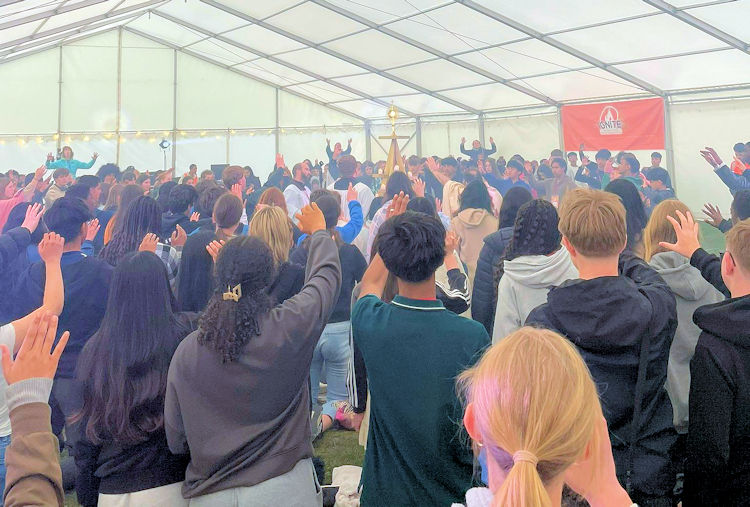
The Catholic Diocese of East Anglia is seeing the effects with more young people than ever (around 350) attending the Ignite Festival in early May said Hamish MacQueen, director of youth services.
“There is a thriving teenage youth group at St John’s Cathedral of up to 40 people meeting each week, including a number of non-churched youngsters, who have come along with friends. They say they like the talks, which are quite evangelistic,” said Hamish.
The national Flame event at Wembley Arena in March saw 10,000 young people listening to Bear Grylls and Cardinal Vincent Nichols, and over 150 from East Anglia attended - more than ever and selling out in record time.
“The experience was so uplifting,” said Simone, 18, from Norwich. “It was amazing to be surrounded by so many young people who share the same faith. I feel so much more connected to the Church now, and I’m inspired to live out my faith in a more meaningful way.”
Responding to the Quiet Revival reports, Hamish said: “I have been seeing it before I knew that others had also. I think that many young people are a bit disillusioned with the state of the world around them, with politics, social media and over wokeness. They want something solid and substantial. Ultimately, It’s the work of the Holy Spirit.”
Key Quiet Revival findings
The growing church
Church attendance in England and Wales is on the rise. This represents a startling change to decades-long trends and presumptions, with the most dramatic increase seen among young people, particularly young men.
In 2018, just 4% of 18–24-year-olds said they attended church at least monthly. Today this has risen to 16%, with young men increasing from 4% to 21%, and young women from 3% to 12%. This is now the second most likely age group to attend church regularly.
Overall, churchgoing Christians now make up 12% of the population, up from 8% in 2018. In numerical terms, that’s growth from 3.7m in 2018 to 5.8m in 2024 – an increase of 56%.
The changing church
In addition to absolute growth in churchgoing, including among the white population, the Church in England and Wales is also becoming more diverse. Just under 1 in 5 churchgoers (19%) are from an ethnic minority, but among 18–54-year-olds this rises to 1 in 3 (32%). At the same time Catholicism has risen sharply and Pentecostalism has become the third biggest Christian tradition, with the share of churchgoers identifying as Anglicans dropping steadily.
67% of churchgoing Christians read the Bible at least weekly outside of church
Practice matters
At the same time, those who don’t engage in practices such as churchgoing or Bible reading are less likely than ever to identify themselves as Christian. Christianity increasingly involves an active commitment rather than a passive cultural label, and there is a clear difference between churchgoing and non-churchgoing Christians.
The spiritual generation
The young people in the sample don’t just go to church more, they show above-average levels of warmth to spirituality, the Church and spiritual practice. This group of 18–24-year-olds are the most likely to pray regularly, with 40% saying they pray at least monthly. More than half of them (51%) have engaged with a spiritual practice over the past six months, compared to 42% of those older than them.
They are also the group most interested in learning more about the Bible, with 37% of 18–24s saying they are curious to discover more about it.
35% of 18–24-yearolds say there is ‘definitely a God/gods or higher power’
Churchgoing and wellbeing
With much of the population, in particular young people, struggling with mental health, loneliness and a loss of meaning in life, Church appears to be offering an answer. We found that churchgoers are more likely than non-churchgoers to report higher life satisfaction and a greater feeling of connection to their community than non-churchgoers. They are also less likely to report frequently feeling anxious or depressed – particularly young women.
63% of 18–34-year-old churchgoers say they feel close to people in their local area, compared to 25% of non-churchgoers their age
Socially engaged congregations
This is not solely about personal development, however, and we also see that churchgoers are more likely to actively participate in activities aimed at benefitting the community around them. Churchgoers are more likely to volunteer, donate to foodbanks and give to charitable causes, demonstrating the positive effect of Christian faith on their lives – and the impact that a rise in churchgoing can have on society as a whole.
79% of churchgoers agree it’s important to them to try to make a difference in the world
Openness and opportunity
The astonishing growth in churchgoing is matched by an openness to Christianity and the Bible: 31% of non-churchgoers say they would attend church if invited by a friend or family member, rising to 34% among 18–24-year-olds. Over half of non-churchgoers (56%) would be happy for a Christian friend to pray for them, while 18% say they would be interested in learning more about the Bible.
Reliable Survey
The 2018 sample surveyed 19,101 adults in England and Wales, while the 2024 sample surveyed 13,146 adults. Both samples therefore give a 1% margin of error at a 99% confidence level, meaning they are highly reliable. The surveys were conducted through YouGov’s online panel.
Find out more
To find out more and download the full report visit: www.biblesociety.org.uk/research/quiet-revival
Are you experiencing the quiet revival in your church? If so please send some details to keith.morris@networknorwich.co.uk
Next week we will look at what Quiet Revival says about why this is happening, what is happening and what the church should do about it.
Read our first article on this topic.
Pictured above is the Diocese of East Anglia Ignite Youth Festival in May.
Please share your own experiences of the Quiet Revival below.