The Holy Trinity and Christian Unity
Dr Ian Watson, County Ecumenical Officer for Norfolk and Waveney, reflects on the connection between the Trinity and unity and why it should bring hope to our ecumenical journey
The mystery of the Trinity has always captivated me. As part of the 1700th anniversary of the Council of Nicaea I’ve been studying some of the Trinitarian writings of the early Church Fathers - especially St Athanasius and the Cappadocian Fathers. As I reflect on the doctrine of the Trinity, which regards the Father, Son, and Holy Spirit as three distinct persons yet one God, I recognise that it not only illuminates the divine nature of the Godhead but also serves as a model and promise for Christian unity.
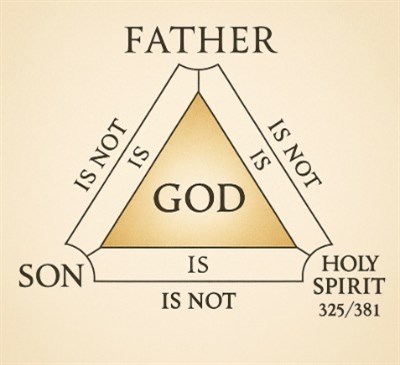
What strikes me most about the Trinity is the juxtaposition of harmony with difference. The Father is not the Son, the Son is not the Spirit, and yet they are inseparably one. They are distinct but not divided. Each person of the Trinity pours love into the others, completely, and without rivalry or dominance. This is not uniformity but communion. I believe that if that is what God is like in His inner divine life, then perhaps we can begin to reimagine what unity might look like for the Church today.
We live in a world, and sadly a Church, that often finds it hard to hold difference in love. Too often our disagreements lead to suspicion, then division, then isolation. We draw lines, build walls, and assume that unity must mean agreeing on everything. The Trinity, however, challenges that assumption. Unity, it tells us, is not the absence of difference, but the embrace of difference within love. Unity is not a narrowing down to sameness, but an opening up to the richness of relationships based on our uniqueness. I don’t know about you, but I find that an incredibly hopeful idea.
I think of Jesus’ prayer in John 17 just before his arrest when he prayed that his followers “may all be one… as we are one.” Surely, that is the unity of the Trinity he’s talking about. A unity rooted in shared life, mutual love, and divine purpose. Jesus wasn’t imagining a church that all looked the same, sounded the same, or worshipped in identical ways. I think he was longing for a church bound together in the same Spirit that bound him to the Father – a unity that can hold together many voices in one song.
The early Church understood this well. Athanasius, one of the great defenders of the Nicene Creed and the Trinitarian faith, wrote: “The Trinity is holy and perfect, acknowledged as one God in three persons. It is the unity of the Trinity that makes the Church one, as the Lord Himself said: ‘That they may be one, as We are one.’” He saw clearly that the Church’s unity was not merely an organisational goal, but a participation in the divine communion itself.
And that, I believe, is why the Trinity gives us hope because we do not create unity out of nothing, we participate in the unity that already exists in God. When we reach out across denominational lines, when we listen with humility and learn from traditions not our own, when we pray and worship together even amidst theological and dogmatic difference, we are not just making polite gestures; rather, we are entering into something eternal, we are tasting (however imperfectly and human) the very communion of the Trinity.
Of course, me simply believing and stating this doesn’t make unity any easier. We all know that reconciliation takes time. Forgiveness is hard and history is heavy with wounds and mistrust which makes it difficult for us to move beyond the walls of defence we have built up in our own traditions. Even if this is so, however, the Trinity should give us courage.
The love that flows between Father, Son, and Spirit is not static or sentimental – it is active, dynamic, and healing. It is the same love that created the world, redeemed it through the cross, and continues to renew it through the Spirit. That love is stronger than division and certainly stronger than our failures - stronger even than death. Surely it is the case that if by His divine nature God is for unity and God is unity then there is always reason to hope!
Sometimes I think we look too far ahead, imagining that Christian unity must be some distant ideal. Perhaps, however, it’s already nearer than we think. Every time churches come together to serve our communities, every time we share worship across traditions, every time we acclaim the Nicene Creed or pray the Lord’s Prayer with one heart, the unity of the Trinity is breaking through.
Our efforts for unity may not yet be perfect, but I believe it is real. If we can learn to see this, celebrate it, and nurture it, we might just find that unity isn’t a destination, it’s a way of walking together as brothers and sisters in Christ’s love in, as the late Pope Francis once said, reconciled diversity. Pope John Paul II once put it this way: “The unity of Christians is a gift of the Holy Spirit. The model for this unity is the unity of the Triune God. Just as the Father, Son, and Holy Spirit are one, so the Church must be one.”
That vision is not beyond our reach as it is grounded in God’s own being. We are not being asked to invent something new, but to step more deeply into a truth that already is. The Trinity reminds us that love is not a vague feeling, but a shared life. And Christian unity, at least at its best, is exactly that sharing life in Christ. Not erasing our distinctiveness but offering our differences generously to one another. Not settling for the lowest common denominator but aspiring to the highest calling; namely, to love one another as God has loved us.
There’s something beautifully humbling about that. It means that unity is not something we achieve by being clever enough or holy enough but it’s something we receive. A gift from God who is unity.
For me the Trinity is a grace that beckons us into deeper communion, again and again. Because of this, even though in my role I am discouraged at times by the lack of progress, when I think about the future of the Church, I remain hopeful. Not because the path forward is simple nor easy (as any ecumenical officer can attest) but because the God who calls us to unity is already ahead of us, guiding us into the divine harmony of love, diversity, and Christian oneness. For me, the Trinity is not just a mystery to be pondered – it’s a promise to be lived.
And in that promise, I find peace and true hope.
Article by Dr Ian Watson whose lay opinions are his alone.