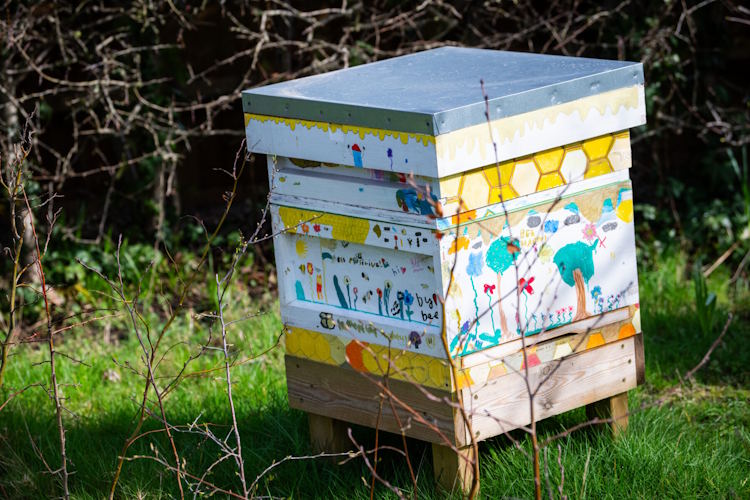
30,000 bees help Gorleston church outreach
An apiary at the church of St Mary Magdalene in Gorleston is helping the church reach out into a community where there is a number of challenges.
Network Norfolk reported on the bee-keeping project at the church back in February this year and, since then, the parishioners have been rallying round to get involved.
St Mary Magdalene serves a parish that has a strong spirit of community, but the Magdalen ward in Gorleston is listed as one of 225 ‘Left-behind Neighbourhoods’ in England. This reflects the dual disadvantage of high levels of deprivation and socio-economic challenges, combined with it lacking the community and civic assets, infrastructure and investment required to mitigate these challenges.
Rev Matthew Price has been the vicar at St Mary Magdalene since January 2018. Right from the start he and his team intentionally reached out to serve the needs of the community. Coming from the next-door parish in Bradwell, just two or three miles away, he could easily have assumed that his new neighbours’ challenges and needs were the same. But he double checked using Church Urban Fund’s Look Up Tool, and found remarkable differences:
With just under 10,000 residents, Magdalen is the 551st most deprived parish in the UK, where 42% of working age people, 36% of pensioners, and 55% of children live in poverty.
With a similar population (11,580) St Nicholas, Bradwell ranks 6,443 out of 12,154, with 17% of working age, 13% of pensioners, and 26% of children living in poverty.
When asked about the usefulness of the deprivation data, Rev Matthew said: “We’ve actively prioritised the most vulnerable in the community, in the neighbourhood, and how we serve them, and let the rest follow on from that.”
Anna Price, Community and Discipleship Lead at the church went further, saying: “We’re committed to raising up people from within the community so that they can take ownership and leadership.”
 Anna and her colleague Anna Heydon, Deputy Community Lead, right, have found the CUF data critical in guiding their programmes. They work as much as possible at grassroots level. They start with people, and what their needs are, but also with what the passion is as well.
Anna H explained: “The data help us to identify the areas of strength and the areas where there is more need, and then shaping the sorts of activities we offer. We’re in an area of higher general deprivation, and one of our particular areas of need is lack of qualifications, so we've run literacy and numeracy classes, and we've also done things like cooking cookery classes. And we do training for our volunteers as well, like the barista training to try and develop people’s skills and have something to be able to offer employers.”
St Mary Magdalene also runs an emergency foodbank, fuel bank and household provision, 10+ volunteer-led community groups and projects, five annual community events, an onsite signposting and advice service, and a structured volunteering programme.
And, of course, the beehives!
Local resident Lynn Ellis started taking her granddaughter to the toddler group at the church and helping out, and heard about the beekeeping. So, she and her daughter went along to a meeting, and then started caring for the bees once a week. “And we absolutely love it - they are fascinating” she said. “When I come on a Wednesday to do the bees, I found myself coming a little bit earlier and earlier, because I was enjoying coming to the Open House café space, too, and enjoying the community.
“I love being involved, and I love helping other people to be involved and just coming and seeing what it's all about. I now do Bible study once a week, I was baptised, and I'm also hoping to get confirmed. It's not a very wealthy area but it is rich in community. You know, people look out for one another and care for one another. What goes on at the church through the week helps that sense of community. There's so much love when you come into this church.”
For Anna Heydon, the work at St Mary’s is reflective of what Jesus did on earth. She concluded, “It is being with people, empowering people, engaging people at whatever stage of their journey, not waiting for them to necessarily have everything sorted in terms of their faith, but engaging them in His work as He was doing it.”
This story is based on an article by the Church Urban Fund, and which also appeared on the Diocese of Norwich website.
The photo of the beehive at the church is also courtesy of dioceseofnorwich.org.
 Do you have a news story or forthcoming event relating to Christians or a church in East Norfolk?
If so, e-mail tony.rothe@networknorwich.co.uk with details and, if possible a suitable picture.
Tony Rothe, 30/04/2026