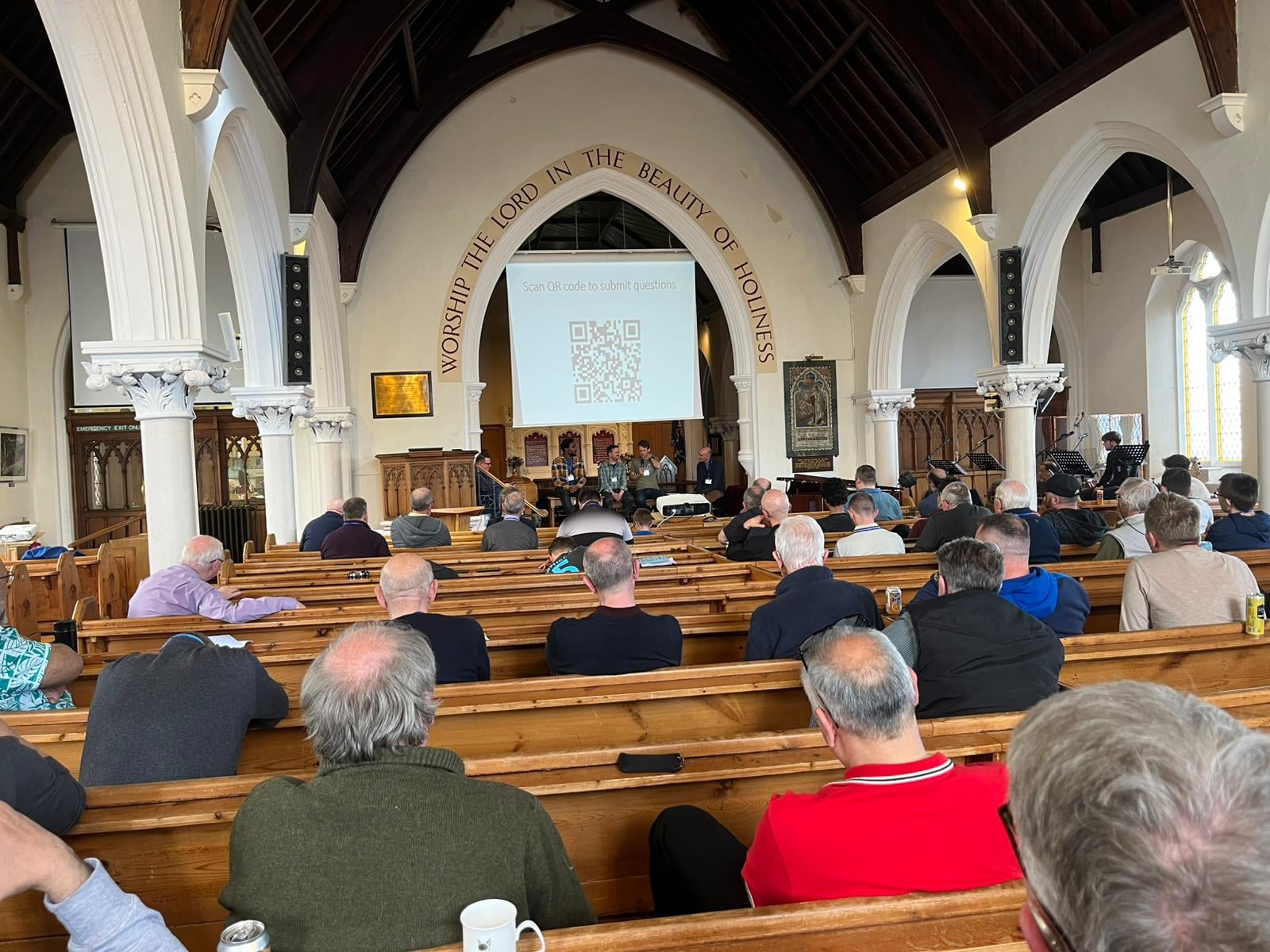
Christian conference on 'what it means to be a man'
On April 25, about 65 men attended the Future Men Conference at Christ Church, Lowestoft. The event featured worship, activities and talks revolving around ‘what it means to be a man’ from a conservative evangelical biblical perspective. Mark Sims reports.
Whilst being part of the Anglican Norwich Diocese, Christ Church holds a ‘complementarian’ view of male headship of church and home. There is also a distinctive ministry for men and women.
Rev Jon Carter led the first main session, ‘How Christ Defines Manhood’. Focusing on Genesis 2-3, he described a biblical view of men and women as housebuilders and homemakers, respectively. Men are typically task-orientated, single-minded and compartmentalising, whereas women think in a more care-orientated, relational and interconnected way. ‘God designed men and women for different roles…’ Jon told us, ‘...not so much differences from each other, as for each other.’
Jon challenged men to consider what houses we are building, imploring us to recover the traditional household, through work and education.
Of the four breakout seminars following the main talk, I attended James Pinto’s Building God’s Kingdom In Your Church. James asked us to consider the two biblical Adams, i.e. the first man in Genesis and Jesus in John’s gospel, and how they handled their respective missions. St. Paul first drew comparison between the two in his epistles, e.g. 1 Corinthians 15:22, ‘Just as all die in Adam, so in Christ all will be brought to life.’
In Genesis, Adam’s mission is to care for the garden of Eden. He is free to enjoy all of its fruits, except those of the tree of knowledge of good and evil. In Genesis 3:6-10, Adam disobeys, demonstrating ‘toxic passivity’ by failing to uphold his calling, unquestioningly following Eve’s lead in biting forbidden fruit, then blaming her and God for the consequences, rather than accept responsibility for his action.
James quoted The Men We Need, in which author Brant Hansen calls Adam ‘passive’, and that a man like him is, ‘a threat to the women in his life.’ James said Adam was ‘de-manned’ by sin. By contrast, in John 2: 13-17, Jesus demonstrates ‘healthy proactivity’ in driving commerce from the temple, using the building as a metaphor for the death and resurrection of his own body, ‘Destroy this temple, and in three days and I will raise it up’. Where the first Adam failed to confront sin in a holy place, the second succeeded.
James challenged men to be more like the second Adam than the first. ‘What does it look like to show up at church?’ James asked, citing the importance of taking responsibility for our spiritual lives - being good teachers, as well as teachable, prayerful, self-disciplined and serving.
James also called men to invest in their ministry. This involved clarity of vision and planning further steps, if there was no men’s ministry at our particular church, e.g. starting a men’s social group.
Finally, James called us to choose today who we will become tomorrow, which is, to quote Brant Hansen, again, ‘a direct result of what we pay attention to’.
During a Q&A session at the end of the conference, one pastor spoke of a male friend of his who finds men’s ministry difficult, struggling to fit the mold presented by other men. The pastor expressed the need to consider how we minister to men who feel excluded.
Photo by Revd. Robert Parsonage
Mark Sims, 02/05/2026