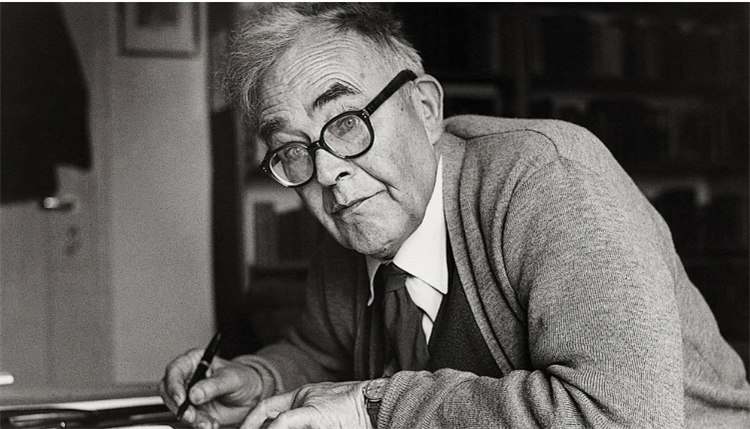
Karl Barth and Christocentric Ecumenism
County Ecumenical Officer, Dr Ian Watson, considers how Karl Barth provides a theological foundation for Christian unity
8-Minute Read
When considering the foundation for ecumenism I think it inevitable that all roads lead to Christ. It is Jesus that connects all Christians regardless of the traditions they belong. As unlikely as it first appears, Karl Barth, a Swiss Reformed thinker and one of the most consequential theologians of the twentieth century, provides an interesting (if not surprising) avenue for ecumenical engagement. He does so by firmly putting Jesus Christ at the very centre of theological thought.
Before I get into that there are a couple of clarifications to make. First, I do not always or completely agree with Barth’s thoughts. For instance, he was a staunch critic of natural theology - the idea that knowledge of God can be obtained through human reason and observation of the natural world. Barth believed revelation comes solely through Jesus Christ. In contrast, I follow St. Thomas Aquinas, who maintains that both reason and natural theology play important roles in leading one to truths about God. I take, therefore, a more nuanced approach than Barth, one that sees faith and reason as complementary – a position exemplified by Pope John Paul II’s encyclical Fides et Ratio.
Second, Barth's emphasis on revelation focuses intensely on Jesus Christ as the supreme revelation of God. He argued that Christ is the Word of God and that Scripture is primarily a witness to this Word. Of course, I also hold Christ as the fullness of revelation but, unlike Barth, I see Scripture and Tradition together as how this revelation is authentically transmitted and interpreted. This is in line with the dogmatic constitution Dei Verbum from Vatican II, which articulates that Scripture and Tradition are bound closely, both flowing from the same divine wellspring.
That being said, I think it is of immense value to consider Barth’s Christocentrism. By doing so we can better enable ecumenical dialogue by setting aside (at least temporarily) sectarian limitations on our Christian faith that may arise from our respective denominational confessions.
For Barth, Christian theology begins and ends in Jesus. Christ is the living Word of God, who reveals God’s character, elects humanity in grace, and reconciles creation to the Creator. Revelation, for Barth, is not a generic discourse about God or even a book of propositions, it is the self-communication of the Triune God in the Word made flesh - Christ himself.
This Christocentric orientation facilitates ecumenism in two interlocking ways. First, by relocating primary authority from human systems (from whatever tradition or church) to the person of Christ. In doing so it neutralises, or at least reduces, many confessional barriers that historically divided Western Christianity. This only works, however, if one views his rejection of natural theology (the attempt to locate God through human reason apart from Christ’s revelation) not as an attempt to dismiss other traditions, but as a challenge for all Christians to ground unity in the same Word of reconciliation, rather than in philosophical of theological vocabularies particular to any one confession.
Second, Barth defines the Church’s identity as: “the community of those who hear and confess the Word of God in Christ.” I do not disagree, but my view of the Church is slightly different, for me, it is this but also a spiritual and visible community founded by Christ. Although different, however, both perspectives agree that Christian unity should mirror the unity of Christ’s message. According to Barth, the Church serves as a penitent witness to Christ rather than a flawless institution. Therefore, the shared proclamation of Christ’s Word makes visible unity among Christians essential to faith itself, not just a matter of lesser agreements.
Although cautious about institutional ecumenism, Barth was not aloof from attempts to foster Christian cooperation and witness in a fractured world. His life intersected with the emerging ecumenical movement in the aftermath of the World Wars. He took part in discussions that shaped the early World Council of Churches. He also corresponded enthusiastically with Christian leaders and theologians across confessional lines. Indeed, in many respects Barth journeyed from polemic to partnership with thinkers across different traditions. The most important aspect of these efforts was the resulting mutual respect across different churches. I think this illustrates that serious theological dialogue rooted in Christ can transcend confessional antagonisms.
Whether he intended to or not, Barth offers a method for ecumenism that most Christians can commit to. It begins with the Nicene Creed, that is, the confession of Christ as true God and true man. When Christians from different traditions put Christ at the centre of divine revelation and reconciliation, they share a unified foundation that rises above past conflicts. Barth’s approach, rooted as it is in the creed and our shared faith in the incarnate Word, strengthens ecumenical consensus on the Universal Church’s oneness, holiness, catholicity, and apostolicity - dimensions central to all our different denomination self-understandings.
Karl Barth held the Nicene Creed in very high esteem and regarded it as a normative and authoritative confession of the church’s faith, provided it was rightly understood as a witness to, rather than a replacement for, the living Word of God revealed in Jesus Christ. For him, the Creed is a faithful, necessary, and binding articulation of the church’s encounter with God’s self-revelation in Christ. He saw Nicaea (325) and Constantinople (381) as moments in which the church was compelled by the gospel itself to speak precisely about who Jesus Christ is. In many ways, he viewed the Creed as a non-negotiable ecumenical foundation. In confessing the identity of Jesus Christ at the heart of the gospel, it provides a shared doctrinal ground across Christian traditions. In this respect, his position converges significantly with Catholic, Orthodox, and many Protestant churches. For example, in a recent letter, Pope Leo tells us that the Creed “gives us hope” by being a “reference point in our journey towards unity and reconciliation”.
Practically, this means that ecumenical dialogue should prioritise Christological agreement as the normative centre of theological discourse. Debates about ecclesiology, sacraments, or authority remain important, of course, but they must be addressed always in light of a shared faith in the crucified and risen Christ, whose reconciling work constitutes the core of Christian identity and mission. Barth’s emphasis on Christ thus becomes the anchor for unity.
Barth’s sharp critique of natural theology (among several other critiques not covered here) should not unsettle us if, that is, we remain open and receptive. I think his views are best seen as an invitation for Christians to return to the foundational event of Christ’s revelation when we engage across denominational lines. If we do, Christ is always seen as the most important criterion for all inter-church engagement - a move (surely) that can help defuse confessional pride and foster mutual humility.
Barth’s insistence that matters of faith remain always to be reformed in light of Christ’s Word, should invite continuous dialogue rather than static disagreement. Ecumenism, at least on this view, is not the conclusion of our efforts but an ongoing participation in the self-disclosure of God in Christ. In other words, as Christians we must always focus on the centrality of Christ when seeking to understand the distinctive doctrines and traditions captured in the many different denominations that make up the Church.
As Christians our ultimate goal transcends denominational boundaries. The mystical union with God is available to, and a hope shared by, all believers. At our very core, all Christians are striving for the same deeper relationship with the Divine – Jesus Christ. Recognising this shared aspiration is a source of hope to focus on achieving the goal we share, instead of being distracted by the differences that exist between us.
***
Barth’s writings are rich, extensive and complex. For those who wish to learn more these materials are a good starting point:
-
George Hunsinger, How to Read Karl Barth: The Shape of His Theology.
-
Hans Urs von Balthasar, The Theology of Karl Barth: Exposition and Interpretation.
-
Paul D. Molnar, “Barth and the Nicene Faith” (in Ecclesiology).
Biography
Karl Barth (1886–1968) was a Swiss Reformed theologian and is widely regarded as one of the most influential Christian thinkers of the twentieth century. Born in Basel and educated in Bern, Berlin, Tübingen, and Marburg, Barth began his career shaped by liberal Protestant theology but decisively broke with it during the First World War, concluding that it had too readily aligned itself with modern culture and political power. This rupture led to his landmark Epistle to the Romans (1919/1922), which announced a “theology of crisis” centred on the absolute otherness and freedom of God.
Barth went on to develop a comprehensive Christocentric theology in his monumental, unfinished Church Dogmatics, arguing that God’s self-revelation in Jesus Christ is the sole foundation of Christian faith, doctrine, and ethics. Dismissed from his post in Germany for opposing Nazism and helping to draft the Barmen Declaration (1934), Barth returned to Basel, where he continued his theological work.
Though firmly Reformed, Barth engaged extensively with Catholic theology and the ecumenical movement, becoming a critical but constructive interlocutor across confessional lines. His legacy lies above all in his uncompromising insistence that Jesus Christ is the one Word of God to whom the church must listen, trust, and obey.
Article by Dr Ian Watson whose lay views are his alone.
Photo of Karl Barth courtesy of Christianity Today Oct 2017.