 The Annual NWCT Talk
Now in its second year, this year’s Churches Together in Norfolk and Waveney (NWCT) Talk was on the enduring relevance of Saint John Henry Newman for all Christians today, Dr Ian Watson reports
The annual Churches Together in Norfolk and Waveney (NWCT) Talk, held this year during the Week of Prayer for Christian Unity, took place on Thursday 22 January in the beautiful village of Little Walsingham – England’s Nazareth. It proved to be a joyful and encouraging evening. Around forty people, representing a mix of Christian denominations, and coming from across Norfolk, gathered together in a spirit of warmth and friendship. The Methodist Church itself, so clearly cherished by the local community, helped create an atmosphere that was welcoming, prayerful, and perfectly suited to an ecumenical gathering.
The evening was opened by a warm welcome and prayer from Aileen Fox, the Methodist lay preacher, who was the perfect host. She gave us a brief history of this wonderful Methodist church – if you have not visited, I highly recommend it.
As County Ecumenical Officer, I had the privilege of introducing the talk and reflecting on why Christian unity continues to matter so deeply in today’s world. I spoke about unity not as an abstract ideal but as something rooted in the very heart of Christian faith, particularly as expressed in the Nicene Creed, which Christians across traditions continue to proclaim together, even after an amazing seventeen centuries.
Drawing on the Christian philosopher Alvin Plantinga, I reflected on how confessing the Creed is a communal act that binds believers together and places the Church in a posture of trust before God. I also referred to the words of Pope Leo, who has spoken of the Creed as foundational to the journey towards full communion between Christians.
Against the backdrop of declining faith, social fragmentation, and growing polarisation, I suggested that visible Christian unity offers a hopeful counter-narrative. One that reflects Christ’s prayer “that they may all be one” and strengthens the Church’s witness in the world. I concluded by emphasising that unity does not mean uniformity, but as Pope Francis believed, a reconciled diversity rooted in love, trust, prayer, and shared mission. Click here for a full transcript of my remarks
The main speaker for the evening was Fr Michael Rear, whose address took us on a thoughtful and engaging journey through the enduring relevance of Saint John Henry Newman for Christians today. My admiration for Fr Michael knows no bounds. Here he was giving the talk just 6 days after major heart surgery and full of the Holy Spirit! Thanks be to God.
Drawing on his recent book, Doctor of the Church: An Introduction to St John Henry Newman (2025), Fr Michael presented Newman not simply as a historical figure or theological giant, but as a profound pastoral guide for the contemporary Church. He began by offering some background on Newman’s life, reminding us of his journey from Anglican priest to Catholic convert and eventually to saint and Doctor of the Church. Newman’s life, he suggested, is itself an ecumenical story and one marked by intellectual honesty, deep prayer, and a refusal to take easy or polemical paths. Newman’s conversion was not driven by rejection of others, but by a demanding fidelity to truth as he came to understand it - a point Fr Michael made with great sensitivity.
A significant part of the talk focused on Newman’s life of prayer. Fr Michael highlighted how prayer shaped Newman’s thinking, sustained him through misunderstanding and isolation, and grounded his theological work in humility before God. Newman’s prayers, many of which remain widely used today, reveal a spirituality that is both deeply personal and ecclesial - attentive to conscience, grace, and the slow work of God in the soul. He suggested that this prayerful depth is one reason Newman continues to speak so clearly across denominational boundaries.
Fr Michael also explored Newman’s remarkably prescient awareness of the decline of faith and the rise of secularism. Amazingly, this was at the height of the Church in the West and long before these themes became common currency. Newman perceived that Western society was moving towards a form of practical unbelief, where religious language might remain, but its substance would be hollowed out. Newman’s response, however, was neither despair nor hostility, but a renewed emphasis on the formation of conscience, integrity of belief, and the need for Christians to live convincingly what they profess. Fr Michael showed how this insight makes Newman an especially relevant companion for the Church today as we continue to oppose the draw of secularisation.
At the heart of the lecture was Newman’s understanding of conscience. This was a theme Fr Michael handled with particular clarity. Newman famously described conscience as the “Aboriginal Vicar of Christ” not as a licence for individualism, but as the place where the human person encounters moral truth and the call of God. What Newman meant was conscience is the internal guide placed by God within the soul. It is the voice of God, directing individuals toward objective moral truth and divine law. Fr Michael stressed that for Newman, conscience demands obedience, humility, and responsibility. In a culture that often reduces conscience to personal preference, Newman’s vision challenges Christians to recover its depth and seriousness. This, Fr Michael argued, has profound implications for unity, because it encourages respect for those who sincerely seek to follow God, even where differences remain.
He ended by reminding us that our belief is not developed or sustained by reason and rationality alone, but also through our imagination and faith. This is an idea that many atheists seem not to understand (or simply dismiss) as they continue to place individual autonomy as the highest goal of mankind.
The evening concluded with a strong sense of gratitude for the richness of Fr Michael Rear’s talk, the generosity of the Methodist hosts, and the evident desire among those present to walk together as brothers and sisters in Christ.
The NWCT Talk, only in its second year, once again demonstrates that ecumenical gatherings are not merely symbolic, but places where trust is built, faith is deepened, and hope is renewed. During the Week of Prayer for Christian Unity, it was a timely reminder that unity is not something we manufacture, but something we receive and live. In this endeavour we are guided by the same Spirit at Pentecost who continues to burn brightly for the Church today.
Article by Dr Ian Watson.
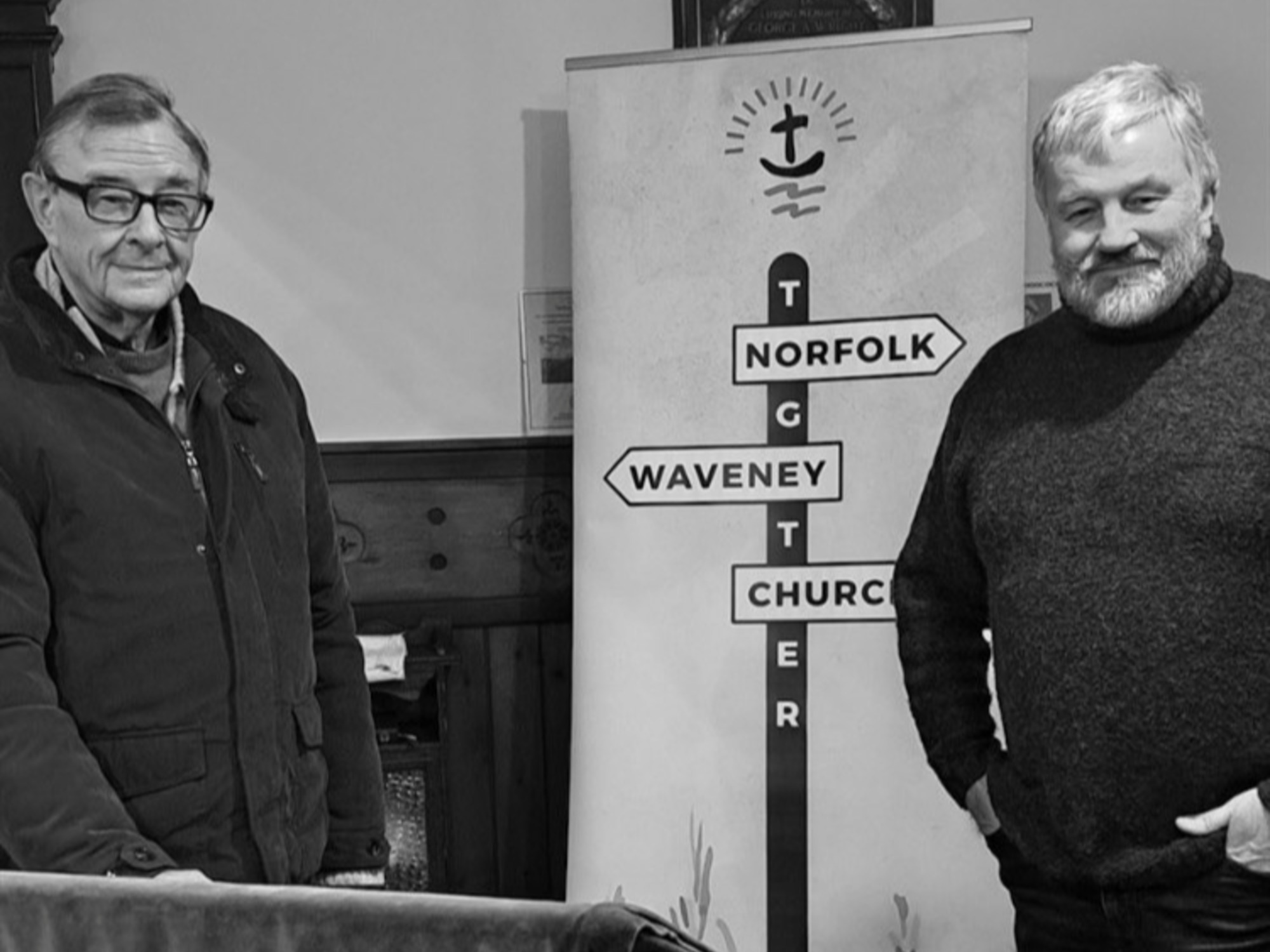
Photo of Fr Michael (left) and Dr Ian Watson courtesy of Aileen Fox, Lay Methodist Preacher.